
The Plight of the "Generically Spectacular"
Observations from the world's largest gathering of college admissions counselors

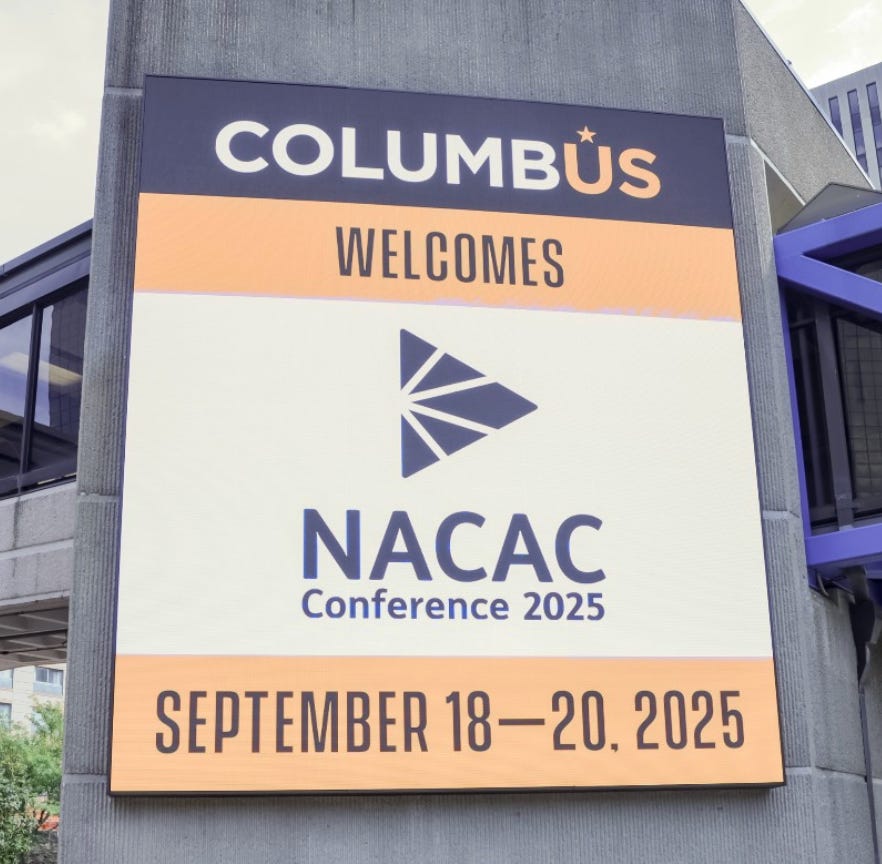
I recently returned from the National Association for College Admissions Counseling (NACAC) conference, where over 6000 people who work in roles related to college admissions gathered for three days of networking, attending sessions, and swapping gossip and tips.
I was there primarily because I’d been invited to give a pre-conference workshop session on direct admissions but I stuck around for the chance to hear Brené Brown speak (she was excellent) and to hit up some of the sessions about college access, applications, and admissions.
When I made my conference schedule, there was one session that I was particularly interested in called “The Plight of the Standard Strong Applicant”. This session, which was led by an admissions officer from Columbia and two independent college counselors, promised a closer look at:
the experiences of the “‘standard strong’ applicants who have done it all: excellent achievement in rigorous courses, significant engagement in school and community activities, and an abundance of positive personal qualities” but who are “not admitted in big numbers - and there are a lot of them. They are not being recruited, are not underrepresented, and are not on the brink of fame.”
This group of students, which was also given the casually devastating label of “generically spectacular”, are the top 10% or higher of their high school class, the 32+ ACT/1450 + SAT scorers, the kids who’ve always known they were smart and always planned on going to college. They are ambitious kids, often with ambitious parents, who occupy “most competitive segment of the applicant pool” have high expectations and an even higher likelihood for admissions related heartbreak. High school counselors are worried about their mental health; admissions counselors are overwhelmed by their mumbers.
Obviously, given my feelings about highly selective schools and the frustrations I have with the on-going narratives that selectivity is a proxy for quality, this was a session I was super curious about.
It turns out I was very, very much not alone in that curiosity.
I arrived to the meeting room for that session about five minuted early and found that the doors were already closed and locked. There was a massive crowd of people all trying to get in, but we were all told that the room was already over capacity. I went to the bathroom, hoping that maybe the crowd would thin out a bit and maybe I could still sneak in somehow. By the time that I got back, there were convention center staff blocking the escalators and police with dogs guarding the doors. I’ve literally never seen anything like it at a higher ed conference before.
Thankfully, the conference organizers were smart and quickly scheduled a second session for this presentation the next day, in a massive ballroom. I got there 15 minutes early and was able to grab a seat, along side about 200 other people who’d been shut out the day before.
Clearly, this was a hot topic.
Now, before I go on, I should note that I think the presenters are all people who likely care about students, who want kids to be able to get into “good colleges”, and who were being generous with their time to do the same session twice.
I also think that they missed a really big opportunity to tell the truth about how to solve the problem of too many well qualified students for too few spaces at highly selective1 colleges and universities.
The presenters shared some idea/facts/reminders that I do think are worth pointing out:
According to admissions professionals at highly selective schools, somewhere between 80-85% of their applicant pool meet their internal criteria for admissions. This means, of course, that of the 90-95% of their applicants that they deny, only maybe 15%-20% of them are denied because they aren’t “good enough”. The vast majority of those rejected are, in fact, just as qualified as the ones who got in.
There are a multiple reasons highly selective schools have gotten even more selective in the recent past2 including a significant increase in the number of people going to college, increased grade inflation making more students think they are qualified for highly selective schools, the false promise of test optional admissions policies, and highly selective institutions trying to game the rankings by engaging in recruit-to-deny activities3
Students who are applying to highly selective schools think their competition is the next smartest kid in their class when the reality is that they are competing with the smartest kids from all over the world
Sadly, the “generically spectacular” student and their parents wildly overestimate their chances of getting admitted and feel like they’ve been lied to or misled by the process. They did everything right, but got rejections and waitlists instead of multiple offers.
The session was designed to offer solutions for how to help these students and families and there were some ideas shared by the presenters:
Students need to do a much better job of personalizing their supplemental essay questions. If they get asked the “why are you interested in this school” question, they should avoid doing a “location+person” response (e.g. “I can see myself walking across the beautiful quad and getting a coffee at the NAME of LIBARY before meeting with Professor Fancypants”) and get at answers that show that they know something about the “DNA of the school”. The admissions rep from Columbia noted that she wants something that convinces her that this applicant is actually prepared to live in NYC, is independent, and can handle a grittier, highly competitive environment.
Students need to stop following advice/trends from Reddit and TikTok. If something is enough of a “hack” or “tip” that people are talking about it on social media, that means admissions offices are HIGHLY aware of it and seeing thousands of applications from students all trying to follow the latest trend to standout
Students should apply to a smaller number of schools and instead take more time to really make their materials are personalized to the school, and, in the words of one of the presenters “colorful, lively, dimensional, and self-aware”. Interesting is better than perfect but it’s also not enough to be competitive… students need to be “compelling and convincing”. So, no pressure there.
On the smaller number of schools thing, the admissions rep from Columbia was blunt and said that application readers at highly selective schools have excellent bullshit detectors and can tell when students are using AI and/or cut and paste answers from one application to the next. To paraphrase her, nobody is actually able to genuinely and in-depth research 20 schools to do 20 really strong, personalized applications and they can tell when students haven’t put in the work to really know a school.
So, here’s the thing: I don’t actually disagree with those suggestions.
BUT
(you knew there was a but coming here, right?)
NONE OF THOSE SUGGESTIONS ACTUALLY SOLVES THE PROBLEM.
If you accept that the problem is that there are too many well qualified applicants who aren’t getting into highly selective colleges… this advice doesn’t change that! It might just shift which of the well qualified applicants get in, but it doesn’t help more of them get in.
The problem is that there are too many students applying for an intentionally limited number of spaces.
Take, for example, the current crop of schools that made the top 10 list in the most recent US News & World report college ranking list: Princeton, MIT, Harvard, Stanford, Yale, University of Chicago, Duke, Johns Hopkins, Northwestern, and University of Pennsylvania.
(Please note that I accurately predicted 9 out of the 10 of these spots in my last post, because these ranking lists are so predictable that they should be considered meaningless!)
According to the most recent application and enrollment data for these schools, they collectively received over 460,000 applications. If we believe the admissions experts who say that at least 80% of those applicants were well qualified, that means that there were over 368,000 applicants who “deserve” a spot. Collectively, they offered admissions to less than 25,000 of those applicants.
Yeah… a better supplemental essay is not going to solve this math problem.
This is a classic supply and demand problem and there are only two solutions:
Increase the number of spots available4, which is highly unlikely for a host of economic, geographical, practical, and philosophical reasons. Harvard has no interest in competing with Arizona State to enroll the most students in the country.
Decrease the number of applicants. There are some ways the colleges could try to do this. They could stop recruiting to deny. They could fully re-implement test score requirements and even set test score minimums5. They could require more application materials and make the admissions process harder … which wouldn’t be popular and would raise some ethical questions but could turn some prospects away.
The truth is that I don’t think the highly selective schools are actively interested in decreasing their number of applications or increasing the number of spots they have available.
So… what then?
In the session, when they opened it up to audience questions, I was the first to raise my hand. The truth was that I didn’t have a question, but I knew my head would explode if I didn’t get to say a (probably slightly less articulate version of ) the following:
We have to start telling students the truth: highly competitive admissions isn’t fair and you can do everything right and still not get in. We - parents and high school counselors and college admissions people - need to do A LOT more to challenge the narrative that selectivity is a proxy for quality. We need to make sure strong students know that they can have great experiences at less selective schools. Public land grant universities can offer tremendous opportunities for Honors colleges and undergraduate research and programs to help prep bright kids for graduate and medical school. Smaller less selective private colleges can offer ambitious students a place to be a big fish in a smaller pond without some of the toxic competition and wealth disparities that advantage the rich and well-connected. We have to stop calling schools “safety schools”. We have to be as excited when your valedictorian is going to the University of Kansas as if they were going to Yale. We have to remember that almost everyone who goes to college is NOT going to a highly selective school and that the research is clear that most people end up feeling good about, and benefitting economically, from wherever they go to school.
Students don’t need better applications. They need better lists of colleges to apply to that include mostly schools where they are actually going to be admitted to and that actually really want to enroll them.
Students deserve to enjoy high school. It should be a time for them to explore things they are interested in academically (whether it is for AP credit or not), to do sports and clubs because they want to and not because they are trying to build a perfect resume, to spend time with friends and family, to get their first job and learn some life skills, to approach the prospect of picking a college with excitement and not anxiety.
We all owe it to students to make sure that they don’t spend four years of high school overworking themselves to chase a goal that isn’t in their control to accomplish and where the odds have been stacked against them the entire time.
Better essays won’t save students from heartbreak. Telling them the truth might.
I did hear some at this conference who suggested we should start calling these schools “highly rejective” schools instead of “highly selective” which is an interesting idea to me.
Affirmative action is NOT one of the reasons, by the way
The presenters did not frame it quite so bluntly, of course
Getting rid of legacy admissions might help a little
There are a good arguments against this idea from people who question the value of standardized test scores
Wow. NAILED IT. SO much great insight here. When you made your comment at the end of their presentation, did any of the panelists respond?
A friend was just commenting that this year, 24,300-ish people were granted entry into the Boston Marathon based on their marathon time. AN ADDITIONAL 8,887 runners *beat the qualifying time* but not by enough to get in. It feels similar to this — you do everything right, but not quite right enough. (I am also obsessed with the police dogs at the door.)